
Table of Contents
ToggleIslamic Calendar — Hijri Calendar, Islamic Date Today & the Complete Muslim Lunar Calendar
Every Muslim has felt it — that instinct to glance at the Islamic calendar and ask: what is the Hijri date today? Which Islamic month are we in? Is it a sacred month? Are the blessed ten days of Dhul Hijjah near?
The Islamic calendar — known as the Hijri calendar or Arabic lunar calendar — is not just a tool for tracking dates. It is the spiritual heartbeat of Muslim life. Every fast, every pilgrimage, every night of worship, and every celebration is anchored to this sacred system of timekeeping that Allah wove into the very fabric of creation. Our live Islamic Calendar on this page displays the islamic date today automatically — the current Hijri date, the Islamic month name in both Arabic and English, and the corresponding Gregorian date alongside it. Updated every single day. Accurate for Muslims worldwide.
Islamic's Calendar - Hijri's Calendar
Connecting to Islamic Hub...
What Is the Islamic Calendar? The Hijri System Explained
The Hijri calendar — also called the Arabic Hijri calendar or Muslim lunar calendar — is a purely lunar calendar of twelve months, containing either 354 or 355 days per year. It was established to mark the greatest turning point in Islamic history: the Prophet Muhammad’s ﷺ migration (Hijrah) from Makkah to Madinah. That blessed journey became year 1 AH (Anno Hegirae — the Year of Migration). Every year since is counted forward from that moment.
Allah confirms this system in the Holy Quran: “Indeed, the number of months with Allah is twelve lunar months in the register of Allah from the day He created the heavens and the earth.” (Surah At-Tawbah, 9:36)
Unlike the Gregorian calendar — which follows the sun — the Islamic lunar calendar follows the phases of the moon. Each new month begins with the sighting of the crescent moon (Hilal). A lunar month lasts either 29 or 30 days. This makes the Islamic lunar calendar date approximately 10 to 11 days shorter than the Gregorian year — which is why Ramadan, Eid, and Hajj fall on different Gregorian dates each year, slowly cycling through all four seasons over a 33-year period
Islamic Date Today — Check Your Current Hijri Date
Millions of Muslims ask this question every single day: what is today’s Islamic date? The today hijri date shown at the top of this page is updated automatically — no manual input, no calculations required. Our calendar displays the current Hijri date accurately for your region, updated every single day without any manual input needed.
One important thing to understand: the hijri date today worldwide is not always identical across all countries. Saudi Arabia uses moon sightings that many nations follow as their reference. But countries like India, Pakistan, Bangladesh, Morocco, and others follow their own local crescent sighting committees, which can result in the Islamic date differing by one day from the Saudi date. This is a normal, well-established difference rooted in classical Islamic jurisprudence — not an error.
Our calendar clearly shows regional variations so you are never caught off guard. Whether you are in Riyadh, Karachi, London, Jakarta, or New York — the current islamic date shown is always relevant to your location.
The Twelve Islamic Months — Names, Meanings & Spiritual Significance
Understanding the Islamic month list is one of the most rewarding things a Muslim can learn. Each of the twelve Islamic lunar months carries its own spiritual character, historical significance, and recommended acts of worship. The today Islamic month is always displayed at the top of this page — but here is what every month means:
1. Muharram — محرم
The first month of the Hijri year and one of Islam’s four sacred months. The Day of Ashura (10 Muharram) is a day of fasting and remembrance. A powerful month to begin the year with sincere worship and repentance.
2. Safar — صَفَر
The second month. Islam has cleared away all pre-Islamic superstitions about this month. It is a month like any other, calling Muslims to consistent worship and deep trust in Allah.
3. Rabi al-Awwal — رَبِيع ٱلْأَوَّل
One of the most beloved months — the birth month of the Prophet Muhammad ﷺ. A time of increased Salawat (blessings upon the Prophet), gatherings of Islamic knowledge, and renewed love for the Sunnah.
4. Rabi al-Thani — رَبِيع ٱلثَّانِي
A month of continuing the spiritual energy of Rabi al-Awwal through consistent good deeds, voluntary fasting, and charity.
5. Jumada al-Awwal — جُمَادَىٰ ٱلْأُولَىٰ
A month with deep roots in early Islamic history, encouraging Muslims to deepen their voluntary worship and strengthen family bonds.
6. Jumada al-Thani — جُمَادَىٰ ٱلثَّانِيَة
A time to remember the pious predecessors of Islam and recommit to Islamic values in daily life.
7. Rajab — رَجَب
One of the four sacred months. The miraculous Night Journey and Ascension of the Prophet ﷺ (Isra wal Miraj) is commemorated in this month. An ideal time for voluntary fasting and increased remembrance of Allah.
8. Sha’ban — شَعْبَان
The bridge between Rajab and Ramadan. The Prophet ﷺ used to fast more in Sha’ban than any other month outside Ramadan. The 15th night (Shab-e-Barat) is a night of seeking forgiveness and spiritual preparation.
9. Ramadan — رَمَضَان
The crown of the Islamic year. The month Ramadan in which the Holy Quran was revealed. Muslims fast from Fajr to Maghrib, perform Tarawih prayers, increase Quran recitation, and seek Laylatul Qadr in the last ten nights.
10. Shawwal — شَوَّال
Eid al-Fitr is observed on 1 Shawwal. Fasting six days in Shawwal is a beloved Sunnah — the Prophet ﷺ said it is like fasting the entire year. A month of joy and continued spiritual momentum.
11. Dhul Qa’dah — ذُو ٱلْقَعْدَة
One of the four sacred months. A time of Hajj preparation, spiritual reflection, and increased voluntary worship as the most virtuous days of the year draw near.
12. Dhul Hijjah — ذُو ٱلْحِجَّة
The final and most magnificent month. Hajj takes place here. The first ten days are the best days of the entire Islamic year. The Day of Arafah (9 Dhul Hijjah) is the greatest single day in the Hijri calendar. Eid al-Adha is celebrated on the 10th.
Which Islamic Month Is It Today?
If you want to know which Islamic month is today or what the current Islamic month is right now — the answer is always live at the top of this page. The hijri month today updates automatically every day, so there is never any ambiguity.
Knowing the today Islamic month matters practically. It tells you whether you are in one of the four sacred months — where voluntary worship carries extra reward. It tells you whether the ten best days of the year are approaching. It tells you whether a Sunnah fast is recommended. The current Hijri date is not just a number — it is your spiritual compass.
The Arabic Hijri Calendar — Reading the Islamic Date in Arabic
The Arabic Hijri calendar is the original form of Islamic date recording — written in Arabic script, used officially across all Muslim-majority countries, and displayed on our page in both Arabic numerals (٢٥ رمضان ١٤٤٦) and English transliteration so every Muslim can read it comfortably.
This matters particularly for Muslims in Saudi Arabia, the UAE, Egypt, and other Arab countries where the Hijri date is used in official and legal contexts. For Muslims in South Asia — India, Pakistan, Bangladesh — the Islamic date is tracked alongside local crescent sighting announcements, which can differ by one day from the Saudi date. Our calendar serves both communities with one unified, accurate display — no confusion, no guesswork.
Hijri to Gregorian Date Conversion
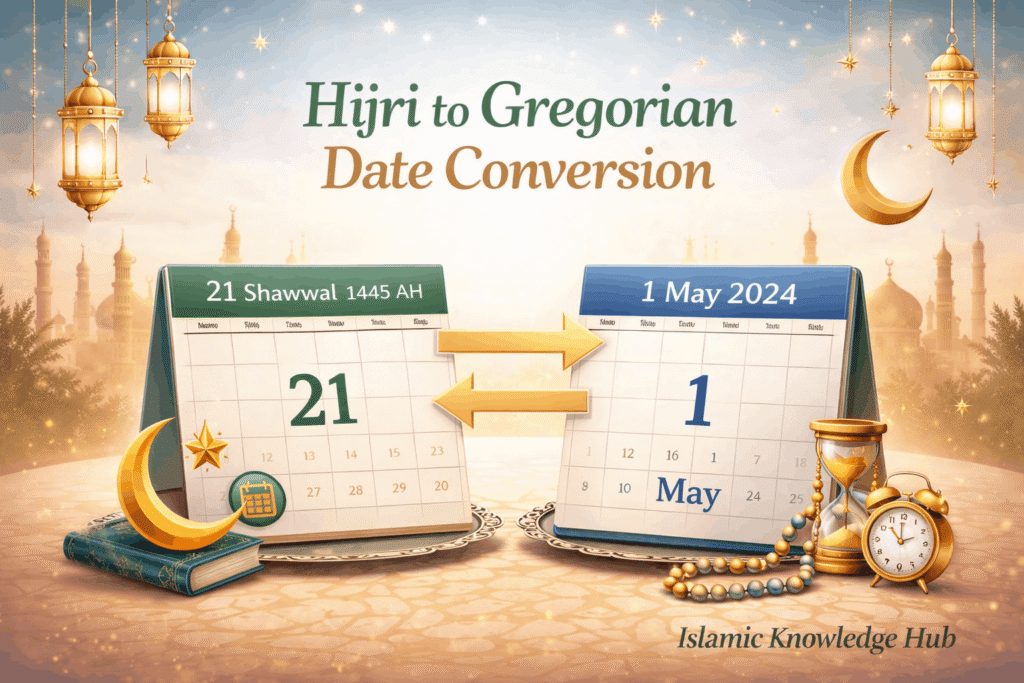
One of the most practical features of our Islamic Calendar is the built-in date converter. Many Muslims need to cross-reference both systems daily — for planning Ramadan travel, booking Hajj, organising Eid gatherings, or explaining Islamic dates to non-Muslim colleagues.
The converter lets you enter any Hijri date and instantly see its Gregorian equivalent — and convert in reverse too. You can browse any Hijri month of any year in the full side-by-side view. Especially useful for educators, families noting children’s birthdays in both calendars, or anyone who needs the Islamic calendar date in a Gregorian context.
Islamic Year Today — What Hijri Year Are We In?
The Islamic year today is in the 1440s of the Hijri era — a number that carries the full weight of Islamic history behind it. Every year that passes in the Hijri calendar is another year measured from the Hijra of the Prophet ﷺ. The exact Islamic year today is always displayed live in the calendar widget at the top of this page. Because the Islamic year is approximately 11 days shorter than the Gregorian year, the Hijri year advances faster — which is why Muslims born in the same Gregorian year can have different Hijri birth years depending on the month they were born.
How to Use the Islamic Calendar Every Day
The Islamic calendar is most powerful when it becomes part of your daily routine — not just something you check before Ramadan. Here is how to make it a living practice:
- Check the current Islamic month every morning to know whether you are in a sacred month, a month of preparation, or a month of celebration — and adjust your worship accordingly.
- Use the Islamic date to track voluntary fasting days: Mondays and Thursdays, the White Days (13th, 14th, 15th of each month), and the days of Ashura and Arafah.
- Pair it with our Islamic Prayer Times tool for a complete, disciplined daily Islamic schedule.
- Plan ahead for Islamic events — Ramadan preparation, Eid arrangements, Hajj registration, Qurbani planning. Our Islamic Events page lists all key dates.
- Teach your children the Islamic month names from a young age — it connects them to 1,400 years of Muslim history and builds a genuine Islamic identity from childhood.
- Explore our Islamic Articles for in-depth guides on the spiritual significance of each Islamic month.
Duas and Worship Throughout the Hijri Calendar
Every month in the Islamic Calendar brings opportunities for worship and supplication. Incorporating duas into your daily routine is one of the most rewarding habits a Muslim can build. Our Duas section offers a growing collection of authentic supplications from the Quran and Sunnah.
For instance, if you are travelling during any Islamic month, recite the Safar Ki Dua for protection and blessings on your journey. Similarly, reciting Ayatul Kursi daily is a powerful Sunnah practice that protects the believer and brings immense spiritual reward.
Daily duas connect the believer to Allah in every moment — from waking up to sleeping. Making dua a regular habit alongside the Islamic calendar creates a deeply spiritual daily routine for every Muslim.
Your Complete Islamic Calendar — Always Accurate, Always Up to Date
Islamic Calendar on Islamic Knowledge Hub updates every single day. Whether you need today’s Hijri date, the full yearly calendar, or simply want to know which month you are in right now — this is your most reliable, free, and authentic Islamic date resource.
Bookmark this page. Share it with your family and your masjid community. Let the Islamic lunar calendar be a constant, living connection between your everyday life and the timeless rhythm of your faith.
جَزَاكَ ٱللَّٰهُ خَيْرًا — May Allah reward you with the very best of goodness.
Q: What is the Islamic date today?
A: The Islamic date today — also called the Hijri date today — is the current date according to the Islamic lunar calendar. It varies by region due to local moon sighting differences. Our live Islamic Calendar updates it automatically every day for your location.
Q: What are the 12 Islamic months in order?
A: The 12 Islamic months in order are: Muharram, Safar, Rabi al-Awwal, Rabi al-Thani, Jumada al-Awwal, Jumada al-Thani, Rajab, Sha'ban, Ramadan, Shawwal, Dhul Qa'dah, and Dhul Hijjah.
Q: What is the Hijri calendar?
A: The Hijri calendar, also known as the Islamic calendar or Arabic lunar calendar, is a lunar calendar of 12 months and 354–355 days per year. It was established to mark the year of the Prophet Muhammad's ﷺ migration (Hijrah) from Makkah to Madinah as year 1 AH.
Q: How do I convert a Hijri date to Gregorian?
Use the built-in Hijri to Gregorian date converter on this page. Enter any Hijri date and it instantly shows the Gregorian equivalent — and converts in reverse too.
Q: Which Islamic month is it today?
A: The current Islamic month is shown live at the top of this page and updates automatically every day.
Q: What is the difference between the Islamic calendar and the Gregorian calendar?
A: The Islamic calendar is lunar — it follows the moon and has 354 or 355 days per year. The Gregorian calendar is solar and has 365 or 366 days. This 10-11 day difference means Islamic dates shift earlier each year on the Gregorian calendar.