
Islamic Duas — Complete Collection
Authentic duas from Quran and Sunnah with Arabic text, transliteration, translation and references.
📂 Browse by Category
10 CATEGORIESMorning Duas
Start your day with Allah
Evening Duas
End your day with gratitude
Travel Duas
Stay protected on journeys
Food Duas
Before and after eating
Sleep Duas
Duas before sleeping
Protection Duas
Shield from evil and harm
Forgiveness Duas
Seek Allah's forgiveness
Marriage Duas
Duas for marriage & family
Success Duas
Duas for success & guidance
Quran Duas
Powerful duas from the Quran
🕌 Recently Added Duas
0 TOTAL🔗 Quick Links
⭐ Essential Duas
Safar ki Dua (Dua for Travelling) — سفر کی دعا
Every journey begins with a single step — and for a Muslim, that step starts with a word to Allah. The Safar ki Dua, known in English as the Dua for Travelling, is one of the most cherished supplications in Islam. Whether you are boarding a flight, stepping into a car, or setting off on a long road trip, this dua is the believer’s first act before any journey begins.
Rooted in the Holy Quran — specifically Surah Az-Zukhruf, Verses 13 and 14 — and further enriched by the teachings of the Prophet Muhammad ﷺ in authentic Hadith, this supplication is far more than a ritual. It is a heartfelt acknowledgment that every vehicle, every road, and every safe arrival is a gift from Allah alone.
This complete guide gives you the Safar ki Dua (Dua For Travelling) in Arabic text, Roman English transliteration, English translation, a detailed Tafsir, key benefits, and answers to the most frequently asked questions — everything you need in one place to read online or download as a PDF.
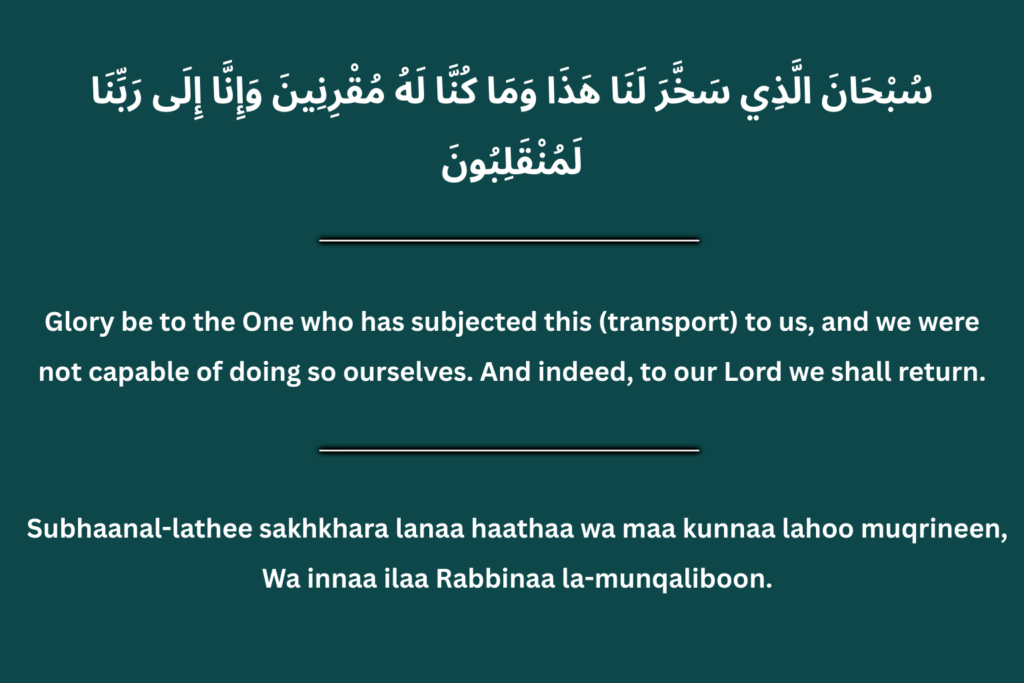
Safar ki Dua (Dua for Travelling) in Arabic (سفر کی دعا عربی میں)
سُبْحَانَ الَّذِي سَخَّرَ لَنَا هَٰذَا وَمَا كُنَّا لَهُ مُقْرِنِينَ وَإِنَّا إِلَىٰ رَبِّنَا لَمُنقَلِبُونَ
Hadith Addition — Sahih Muslim (1342)
The Prophet Muhammad ﷺ personally taught an extended supplication to his Companions whenever he began a journey. This is narrated in Sahih Muslim (Hadith 1342) and Sunan Abu Dawood:
اللَّهُمَّ إِنَّا نَسْأَلُكَ فِي سَفَرِنَا هَٰذَا الْبِرَّ وَالتَّقْوَىٰ وَمِنَ الْعَمَلِ مَا تَرْضَىٰ اللَّهُمَّ هَوِّنْ عَلَيْنَا سَفَرَنَا هَٰذَا وَاطْوِ عَنَّا بُعْدَهُ اللَّهُمَّ أَنْتَ الصَّاحِبُ فِي السَّفَرِ وَالْخَلِيفَةُ فِي الأَهْلِ
Safar ki Dua (Dua for Travelling) in English Translation
Quranic Verses (English)
“Glory be to the One who has subjected this (transport) to us, and we were not capable of doing so ourselves.”
“And indeed, to our Lord we shall return.”
Hadith Addition (English)
“O Allah, we ask You during this journey of ours for righteousness, piety, and deeds that are pleasing to You.
O Allah, make this journey easy for us and let its distance feel short.
O Allah, You are our Companion during travel and our Guardian over our family back home.
Roman Transliteration — Safar ki Dua (Dua for Travelling) in Roman English
For those who want to recite the Safar ki Dua in Roman English while learning the Arabic pronunciation, here is the complete transliteration:
Quranic Verses (Roman)
Subhaanal-lathee sakhkhara lanaa haathaa wa maa kunnaa lahoo muqrineen, Wa innaa ilaa Rabbinaa la-munqaliboon.
Hadith Addition (Roman)
Allaahumma innaa nas’aluka fee safarina haathal-birra wat-taqwaa, Wa minal-‘amali maa tardaa, Allaahumma hawwin ‘alaynaa safaranaa haathaa watwi ‘annaa bu’dah, Allaahumma Antas-saahibu fis-safari wal-khaleefatu fil-ahl.
Tafsir — Detailed Explanation of Safar ki Dua (Dua For Traveller)
Understanding the Tafsir of the Dua for Travelling is what transforms it from a habit into a living conversation with Allah. Let us go through each part carefully.
“Glory be to the One who subjected this to us…” — What does Sakhkhara mean?
The Arabic word سَخَّرَ (sakhkhara) carries a profound meaning: to tame, to make obedient, to put under the service of another. When Allah says He has “sakhkhara’d” this vehicle for you, He is pointing at something extraordinary — you did not design the engine, you did not create the fuel, you did not establish the laws of aerodynamics. The road itself exists because Allah allowed the earth to be shaped, mined, and paved. Even your own muscles and mind that drove you to board the vehicle are His creation.
This opening phrase plants the seed of tawadu’ (humility) and shukr (gratitude) in the traveller’s heart before the wheels even start turning.
Imam Ibn Kathir (رحمه الله) notes in his tafsir of this verse that the reference to “this” (هَٰذَا) is deliberately broad — it applies to any means of transport in any era, from the camel of 7th-century Arabia to the aircraft of the 21st century. The Quran’s guidance is timeless precisely because its language transcends specific inventions.
“…and we were not capable of doing so ourselves”
This second clause of the first verse is a direct acknowledgment of human limitation. The Arabic phrase مَا كُنَّا لَهُ مُقْرِنِينَ — literally “we were not ones who could have been equal to it” — means that without Allah’s arrangement, no amount of human intelligence, engineering, or effort would be sufficient. This is not a negation of human achievement. It is a recognition of where that achievement ultimately comes from.
“And indeed, to our Lord we shall return”
This is perhaps the most powerful line in the entire dua. In three short words of Arabic — وَإِنَّا إِلَىٰ رَبِّنَا لَمُنقَلِبُونَ — the Quran places every physical journey inside the context of the ultimate journey. You are travelling from City A to City B, yes. But you are also — always — travelling from this world toward Allah.
The word مُنقَلِبُونَ (munqaliboon) specifically refers to a return journey. This dua subtly reminds the believer: this world is not your permanent home. You are returning. Every safe arrival back home is a small glimpse of the greatest return yet to come.
Scholars also note that this line brings tuma’neenah (tranquility of heart). A traveller who truly internalises this verse cannot be consumed by the anxiety of the journey — because they know the final destination is in the hands of the Most Merciful.
The Hadith Addition — A Dua Taught Personally by the Prophet ﷺ
The extended supplication from Sahih Muslim adds four specific requests that complete the journey dua beautifully:
- Birr (righteousness) — a request that the journey itself be a source of goodness, not just in arrival but in conduct along the way.
- Taqwa (God-consciousness) — that we remain aware of Allah throughout the journey.
- Pleasing deeds — that whatever we do on this trip earns His approval.
- Ease of the journey — a practical, human request that Allah ease any hardships, shorten the feeling of distance, and protect the family left behind.
The final line — “O Allah, You are our Companion in travel and our Guardian over our family” — is one of the most emotionally moving lines in all of Islamic supplication. The Prophet ﷺ understood that when a person travels, two worries pull at their heart: their own safety on the road, and the safety of the ones they left behind. This dua addresses both in a single breath.
Benefits of Safar ki Dua (Dua for Travelling)
The benefits of reading the Dua for Travelling go far beyond superstition or habit. Each benefit is grounded in Islamic theology and the lived experience of millions of believers.
1. Allah’s Protection Over the Journey
When a traveller recites this dua sincerely, they are placing themselves under Allah’s care. The Prophet ﷺ never left on a journey without it, and his consistent practice is itself a testimony to its value. This is not a guarantee that nothing will go wrong — it is a declaration that whatever happens, you are in Allah’s hands.
2. Eliminating Travel Anxiety
Fear before travel — especially long journeys or flights — is a common human experience. This dua offers something no medication or reassurance can: a genuine transfer of trust from one’s own limited control to Allah’s unlimited power. Reciting it with understanding visibly calms the heart.
3. Turning the Journey into an Act of Worship
By beginning with the name of Allah and reciting His words, the traveller transforms an ordinary departure into an act of ibadah (worship). The journey itself becomes a continuation of your relationship with your Creator — every mile travelled in His remembrance carries reward.
H3: 4. Strengthening Tawakkul (Trust in Allah)
The first verse of this dua is structurally a lesson in tawakkul. You acknowledge that you could not have made this vehicle serve you by yourself. That acknowledgment, repeated at every journey, gradually rewires the heart to trust Allah in all other areas of life too — not just travel.
H3: 5. Keeping the Remembrance of the Akhirah Alive
In the rush of daily life, it is easy to forget that this world is temporary. The Safar ki Dua, recited multiple times a week by an active traveller, inserts a powerful reminder of the Hereafter into the ordinary rhythm of life. This is one of the most underappreciated spiritual benefits of this supplication.
H3: 6. Following the Sunnah of the Prophet ﷺ
Following the Sunnah is itself a beloved act in Islam. Reciting the same words that the Prophet ﷺ recited before every journey creates a spiritual connection across fourteen centuries — and carries the reward of sunnah alongside the reward of the dua itself.
When and How to Recite the Safar ki Dua (Dua for Travelling)
The dua for a traveller is most powerfully recited at a specific moment: when you mount or board your vehicle and it is about to move. This is directly based on the practice of the Prophet ﷺ as narrated by Ibn Umar (RA) in Sahih Muslim.
The recommended sequence is:
- Say Bismillah when entering the vehicle.
- Once seated and the vehicle is about to depart, say Allahu Akbar three times.
- Recite the Safar ki Dua from Surah Az-Zukhruf (43:13-14).
- Follow with the extended dua from Sahih Muslim 1342.
- Make personal dua for your family, your purpose of travel, and a safe return.
This dua applies to all forms of travel — cars, planes, buses, trains, ships, motorcycles, and even long walks. There is no minimum distance required by the Sunnah. Making it a habit for even a short daily commute is a beautiful way to keep the heart connected to Allah throughout the day.Safr
Q: When should Safar ki Dua be recited?
A: The Safar ki Dua should be recited when you mount or board your vehicle and are about to begin your journey — whether by car, plane, ship, or any other means of transport. The Prophet ﷺ would say it after saying Allahu Akbar three times, once seated in the vehicle.
Q: Is Safar ki Dua mentioned in the Quran or Hadith?
A: Yes. The primary text of the Safar ki Dua comes directly from Surah Az-Zukhruf (43:13–14) in the Holy Quran. The extended supplication is authenticated in Sahih Muslim (Hadith 1342) and Sunan Abu Dawood — two of the most authoritative collections in Islamic scholarship.
Q: What is the dua to read when returning from a journey?
A: When returning from a journey, the Prophet ﷺ would add the words: "Aa'iboona, taa'iboona, 'aabidoona, li-Rabbinaa haamidoon" — meaning "We return, repenting, worshipping, and praising our Lord." This is also narrated in Sahih Muslim (1342) as part of the same journey supplication.
Q: What are the benefits of Safar ki Dua?
A: The benefits of Safar ki Dua include protection, blessings, peace of mind, and following the Sunnah of Prophet Muhammad ﷺ.
Q: What is Safar ki Dua?
Safar ki Dua is an Islamic supplication recited by Muslims before starting a journey to ask Allah for safety and blessings.