
zZainab Name Meaning in Islam: Arabic Meaning, Quran & Islamic History
Zainab (زَيْنَب) is an Arabic girl’s name traditionally understood in Arabic lexicography in connection with a beautiful, fragrant flowering plant or tree. It is an established Muslim name with deep Islamic historical significance because several respected women in the early Muslim community were named Zaynab.
Important: Zainab is not mentioned by name in the Quran, although Zaynab bint Jahsh رضي الله عنها is the woman referred to in Quran 33:37.
Zainab Name Meaning at a Glance
| Detail | Answer |
| Name | Zainab / Zaynab |
| Arabic | زَيْنَب |
| Gender | Girl |
| Origin | Arabic |
| Primary Arabic meaning | A beautiful, fragrant flowering plant/tree |
| Islamic status | Established and permissible Muslim name |
| Quranic name? | No, the name itself is not mentioned in the Quran |
| Pronunciation | Commonly pronounced ZAY-nab |
| Common variants | Zaynab, Zeinab, Zaineb, Zenab, Zineb |
| English meaning | Fragrant flower / fragrant plant; beautiful flowering plant |
What Does the Name Zainab Mean?
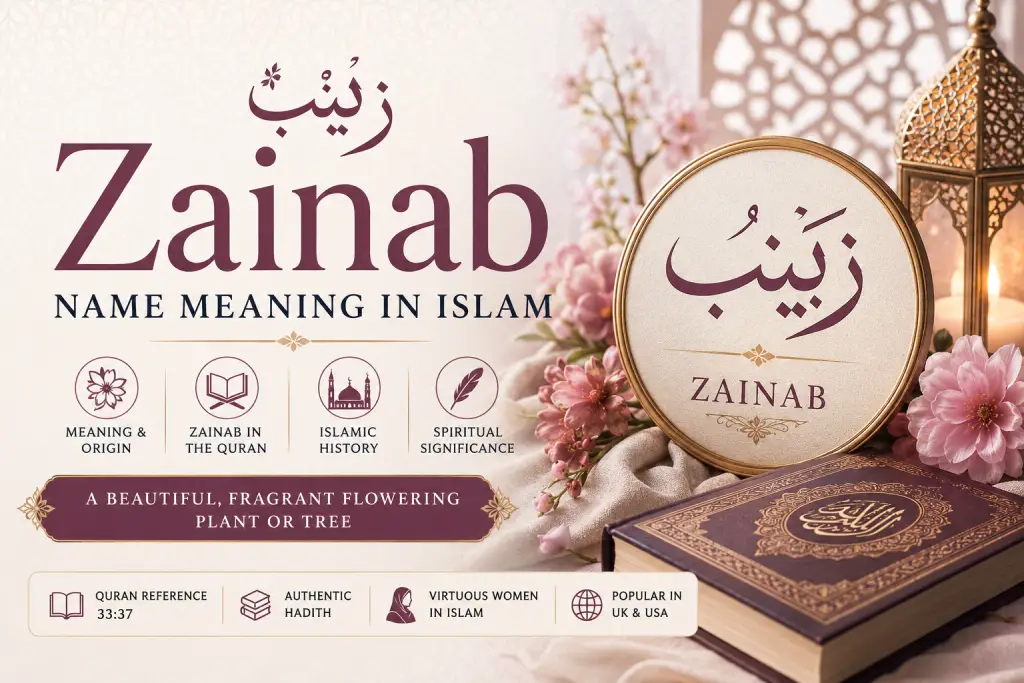
The most reliable linguistic explanation connects زَيْنَب (Zaynab) with a beautiful plant or tree known for its fragrance. Arabic lexicographical sources describe زينب as a plant with attractive flowers and a pleasant fragrance.
Because the exact historical etymology of the name is debated, it is better not to present every popular internet explanation as established fact.
You may see websites translate Zainab as “father’s precious jewel” or explain it as zayn (beauty/adornment) + ab (father). This explanation is widespread, but the etymology is not certain. Classical Arabic usage supports the fragrant-plant interpretation more securely.
Therefore, if you are choosing the name for your daughter, the safest concise meaning is:
Zainab means a beautiful, fragrant flowering plant or tree.
Is Zainab an Islamic Name?
Yes. Zainab is an established Islamic name.
Islam does not require every Muslim name to appear in the Quran. Many respected Muslims, including Companions and members of the Prophet’s ﷺ family, had names that are not Quranic proper names.
The name Zaynab has a particularly strong Islamic connection because it was carried by several women from the Prophet Muhammad’s ﷺ family and household, including:
-
Zaynab bint Muhammad رضي الله عنها — the Prophet’s ﷺ daughter.
-
Zaynab bint Jahsh رضي الله عنها — one of the Mothers of the Believers and the woman referred to in Quran 33:37.
-
Zaynab bint Khuzaymah رضي الله عنها — a wife of the Prophet ﷺ, known for her generosity toward the poor.
-
Zaynab bint Ali رضي الله عنها — the daughter of Ali ibn Abi Talib and Fatimah رضي الله عنهما and granddaughter of the Prophet ﷺ.
The name therefore has a long-established place in Islamic history.
Is the Name Zainab Mentioned in the Quran?
No. The proper name Zainab does not appear explicitly in the Quran.
However, the Quran refers to Zaynab bint Jahsh رضي الله عنها in Surah Al-Ahzab 33:37.
The verse describes the Prophet ﷺ telling Zayd ibn Harithah رضي الله عنه to keep his wife and fear Allah. After Zayd’s marriage to her ended, Allah says that she was married to the Prophet ﷺ so that there would be no difficulty for believers concerning the former wives of their adopted sons.
This passage established an important legal distinction between an adopted child and a biological son.
So there is an important difference:
“Zainab is a Quranic name” — not technically correct.
“Zainab is an Islamic name associated with a woman mentioned in the context of Quran 33:37” — correct.
Zainab in the Quran: What Does 33:37 Actually Refer To?
Quran 33:37 refers to Zaynab bint Jahsh رضي الله عنها, although her name is not stated in the wording of the verse itself.
The verse is significant because it addresses the pre-Islamic understanding of adoption and makes clear that an adopted son is not the same as a biological son in lineage and legal rulings.
This is also why the story should not be reduced to a simple “Zainab was mentioned in the Quran” statement. The actual Quranic context is about lineage, marriage law and the distinction between adoption and biological parentage.
What Do Authentic Hadith Say About Zaynab?
Zaynab is not merely a name found in later Islamic naming traditions. Authentic Hadith collections contain important references to women named Zaynab.
Zaynab bint Jahsh رضي الله عنها and Charity
In Sahih Muslim 2452, Aisha رضي الله عنها reported that the Prophet ﷺ said that the wife with the “longest hand” would be the first to join him after his death.
The wives initially understood this literally and measured their hands. Aisha later explained that Zaynab bint Jahsh رضي الله عنها had the longest hand because she worked with her hands and spent what she earned in charity.
The important lesson is not physical appearance. It is generosity and giving.
For parents choosing the name Zainab, this is a particularly meaningful Islamic association: Zaynab bint Jahsh was remembered for practical charity and generosity.
Zaynab, Daughter of the Prophet ﷺ
Sahih al-Bukhari also records the Prophet ﷺ carrying Umamah, the daughter of Zaynab, during prayer. The narration identifies her as the daughter of Zaynab, the daughter of Allah’s Messenger ﷺ.
This provides direct Hadith evidence for the historical use of the name within the Prophet’s ﷺ own family.
Who Was Zaynab bint Muhammad رضي الله عنها?
Zaynab bint Muhammad رضي الله عنها was the daughter of Prophet Muhammad ﷺ.
Her life is remembered as part of the early history of Islam and the family of the Prophet ﷺ. Her name therefore carries a strong connection to the Prophet’s household.
For Muslim parents, this historical association can be more meaningful than assigning an invented “personality” to a name.
A name does not determine whether a child will become generous, patient or righteous. What matters is how the child is raised and the values she learns.
Who Was Zaynab bint Jahsh رضي الله عنها?
Zaynab bint Jahsh رضي الله عنها was one of the wives of the Prophet Muhammad ﷺ and therefore one of the Mothers of the Believers.
Her marriage to the Prophet ﷺ is directly connected to Quran 33:37.
She is also remembered in authentic Hadith for her charity. Sahih Muslim records that she worked with her hands and gave her earnings in charity.
That gives the name Zainab an especially strong association with:
- generosity
- charitable giving
- work and self-reliance
- faith
- dignity
- service to others
These are historical examples, not personality predictions based on the name itself.
Who Was Zaynab bint Khuzaymah رضي الله عنها?
Zaynab bint Khuzaymah رضي الله عنها was another wife of the Prophet ﷺ.
She was known for caring for people in need and became associated with the title Umm al-Masakin, meaning “Mother of the Poor.”
Her life adds another charitable association to the name Zainab.
This is important because several different women in early Islam carried the name. Their individual lives should not be merged into one biography.
Zainab bint Ali رضي الله عنها
Zaynab bint Ali رضي الله عنها was the daughter of Ali ibn Abi Talib رضي الله عنه and Fatimah رضي الله عنها and the granddaughter of the Prophet Muhammad ﷺ.
She is particularly remembered in Islamic history for her courage, eloquence and steadfastness during difficult events after the death of her brother Husayn رضي الله عنه.
Because traditions differ in how later historical accounts evaluate particular details, it is better to distinguish established historical facts from later narratives rather than presenting every popular story as an authentic Hadith.
Is “Father’s Precious Jewel” the Authentic Meaning of Zainab?
This is one of the most important points for parents researching the name.
You will frequently see:
“Zainab means father’s precious jewel.”
This is a popular modern explanation, but it should not be presented as the undisputed literal etymology of زينب.
The etymology of Zaynab is uncertain, while Arabic lexicographical evidence supports the interpretation of a beautiful, fragrant plant/tree.
The “father’s precious jewel” explanation may be used as a poetic interpretation, but it is better not to label it the definitive Arabic meaning.
For an authenticity-focused Islamic name website, this distinction matters.
How Is Zainab Written in Arabic?
The Arabic spelling is:
زَيْنَب
Without vowel marks, it is commonly written:
زينب
The same Arabic name may be transliterated into English in several ways.
Common spellings
- Zainab
- Zaynab
- Zeinab
- Zaineb
- Zenab
- Zineb
These spellings generally refer to the same Arabic name, although pronunciation can vary between languages and regions.
For English-speaking parents in the UK and USA, Zainab and Zaynab are two of the most recognizable transliterations.
How Do You Pronounce Zainab?
A common English pronunciation is:
ZAY-nab
The exact pronunciation can vary according to Arabic dialect and the speaker’s native language.
When possible, parents should listen to a native Arabic pronunciation rather than relying entirely on English phonetics.
Is Zainab a Good Muslim Baby Girl Name?
Yes. Zainab is a well-established and suitable Muslim girl name.
Its strongest advantages are:
- It has an established Arabic linguistic tradition.
- It has been used by respected women in early Islamic history.
- It has a positive association with beauty and fragrance.
- It has direct connections to the Prophet’s ﷺ family and household.
- It does not carry a meaning that conflicts with Islamic beliefs.
There is no requirement that a Muslim girl’s name must appear in the Quran. A good name can be acceptable because of its sound, meaning, linguistic origin and established Muslim usage.
Does Zainab Have a Lucky Number in Islam?
No Islamic evidence establishes a lucky number for the name Zainab.
Some baby-name websites assign the number 6 to Zainab through numerology. Numerology, however, is not a Quranic or authentic Hadith method for determining a person’s fortune, personality or future.
Therefore, parents should not treat a “Zainab lucky number,” lucky colour, lucky stone or lucky day as an Islamic teaching.
If you are choosing an Islamic name, focus on its meaning, permissibility and good historical associations, not numerology.
Zainab Name Meaning in English
Zainab Name Meaning In English, the most reliable concise rendering is:
Zainab — a beautiful, fragrant flowering plant or tree.
The name is also strongly associated with respected women in Islamic history, including members of the Prophet Muhammad’s ﷺ family and household.
Zainab Name Meaning in Urdu
Zainab Name Meaning In Urdu, Zainab is written:
زینب
A concise meaning can be expressed as:
خوشبودار اور خوبصورت پھول یا پودا
Meaning: a fragrant and beautiful flower or plant.
The name is widely recognized in Muslim communities and is also written in English as Zainab or Zaynab.
Zainab vs Zaynab vs Zeinab
These are usually transliteration differences rather than completely different names.
| Spelling | Arabic | Common use |
| Zainab | زينب | Very common English transliteration |
| Zaynab | زينب | Closer transliteration used by many Islamic sources |
| Zeinab | زينب | Common regional spelling |
| Zaineb | زينب | Alternative English spelling |
| Zenab | زينب | Simplified transliteration |
| Zineb | زينب | Common in some North African/French contexts |
If you are naming a baby in the UK or USA, Zainab is straightforward for English-language forms, while Zaynab more closely reflects the Arabic transliteration used by many Islamic sources.
Final Verdict: Should You Choose the Name Zainab?
Zainab is a strong and historically established Muslim girl name.
Its linguistic meaning is associated with a beautiful, fragrant plant or tree, while its Islamic significance comes from the many respected women who carried the name.
The name itself is not mentioned as a proper name in the Quran, so calling it a “Quranic name” would be inaccurate. However, Zaynab bint Jahsh رضي الله عنها is the woman connected to the event described in Quran 33:37, and authentic Hadith also document women named Zaynab from the Prophet’s ﷺ family and household.
For parents in the UK, USA or elsewhere who want a traditional Muslim girl’s name that works naturally in an English-speaking environment, Zainab offers a combination of Arabic heritage, Islamic history and a positive meaning without relying on unsupported numerology or invented personality claims.