
Islamic Prayer Times — Your Complete Guide to Namaz Time, Salah Timetable & All Five Prayers
Table of Contents
ToggleFive times every day, more than 1.8 billion Muslims around the world pause whatever they are doing, face the Qibla, and stand before their Creator. From the pre-dawn stillness of Fajr to the quiet of Isha at night, the Islamic prayer times are not just a schedule — they are the heartbeat of a Muslim’s day. They divide time into meaning, turn ordinary hours into acts of worship, and keep the believer anchored to Allah no matter how loud the world becomes.
Today's Prayer Times - 03 April 2026
Global Prayer Times
Accurate Salah timings and Islamic schedules for Muslim communities worldwide. Select your country to get started.
🌍 Prayer Times by Country
TOP 10 COUNTRIESIndia
Prayer Times in India
VIEW TIMES →Pakistan
Prayer Times in Pakistan
VIEW TIMES →Saudi Arabia
Prayer Times in Saudi Arabia
VIEW TIMES →UAE
Prayer Times in UAE
VIEW TIMES →United Kingdom
Prayer Times in UK
VIEW TIMES →USA
Prayer Times in USA
VIEW TIMES →Bangladesh
Prayer Times in Bangladesh
VIEW TIMES →Indonesia
Prayer Times in Indonesia
VIEW TIMES →Turkey
Prayer Times in Turkey
VIEW TIMES →Egypt
Prayer Times in Egypt
VIEW TIMES →Whether you are looking for your namaz time today by location, want to understand how the salah timetable is calculated, or are simply learning about each of the five prayers for the first time — this guide covers everything you need, in one place, in a way that never goes out of date.
Use the prayer times widget above to find accurate, live Muslim prayer times for your exact location right now. And read on to understand the wisdom, the science, and the soul behind each prayer.
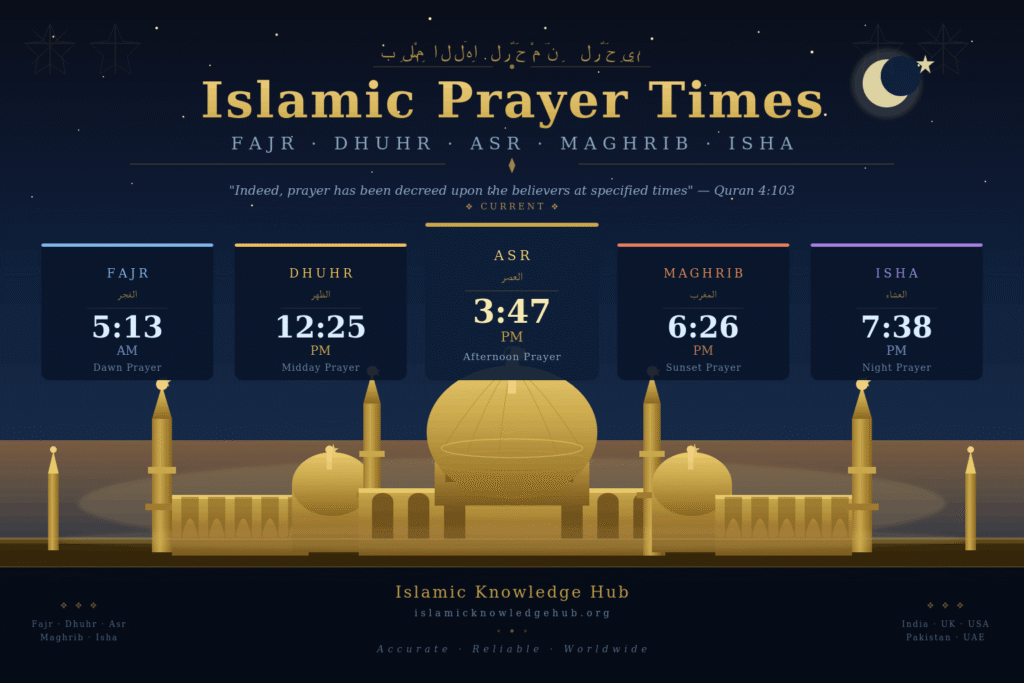
The Five Daily Prayers — Names, Times and Their Significance
Allah says in the Quran: “Indeed, prayer has been decreed upon the believers a decree of specified times.” (Surah An-Nisa, 4:103)
This single verse establishes something profound — salah is not flexible by personal preference. Each prayer has a defined window, and performing it within that window is itself an act of obedience. Here is your complete guide to every prayer in the Muslim prayer timetable.
Fajr Prayer Time — The First Light, The First Salah
Fajr is the dawn prayer and the first salah of the Islamic day. Its time begins at true dawn (Subh Sadiq) — the moment the first horizontal light appears across the horizon — and ends at sunrise. This window is typically between 60 to 90 minutes, depending on your location and the season.
The Prophet Muhammad ﷺ said: “The two rak’ahs of Fajr are better than the world and everything in it.” (Sahih Muslim)
That is the weight of this prayer. And yet, Fajr is the one most people find hardest to pray — because it demands waking before sunrise, before the day’s comfort begins. But those who pray Fajr consistently report something remarkable: their mornings feel clearer, their days more blessed, their minds calmer.
Fajr prayer time changes every day throughout the year because it is directly tied to sunrise, which shifts with the seasons. In winter, Fajr in cities like London or Toronto can be as late as 6:30 AM. In summer, it can begin as early as 2:45 AM. In Hyderabad, India, Fajr typically falls between 4:50 AM and 5:40 AM across the year. In New York, it ranges from approximately 4:00 AM in summer to 6:15 AM in winter. This is why checking your fajr salah time daily — through a reliable prayer timetable — is essential.
Dhuhr Prayer Time — The Midday Anchor
Dhuhr, often spelled Zuhr, is the midday prayer. Its time begins after the sun passes its zenith — its highest point in the sky — and continues until the Asr prayer time begins. This is typically around early to mid-afternoon depending on location.
In the middle of school runs, office meetings, and daily routines, Dhuhr arrives as a quiet command to pause. It is a midday anchor — a reminder that no worldly task is more important than standing before Allah. Many Muslims who pray Dhuhr at work or school report that this brief interruption actually increases their focus for the rest of the afternoon.
Zohar namaz time (as it is commonly searched in South Asia) typically falls between 12:00 PM and 1:30 PM in most countries, though this varies significantly by latitude. In Salah times in Saudi Arabia, Dhuhr in Makkah and Riyadh generally begins around 12:15–12:30 PM. In Islamic prayer times in India, Dhuhr across cities like Delhi, Mumbai, and Hyderabad ranges from 12:00 PM to 1:15 PM. In the USA, Dhuhr prayer time in cities like Chicago and Houston ranges from 12:30 PM to 1:45 PM depending on the season.
Dhuhr prayer time today is always available through the live widget at the top of this pageI.
Asr Prayer Time — Guarding the Afternoon Prayer
Asr is the afternoon prayer, and Allah specifically singles it out in the Quran for emphasis:
“Maintain with care the [obligatory] prayers and [in particular] the middle prayer and stand before Allah, devoutly obedient.” (Surah Al-Baqarah, 2:238)
Scholars of tafsir widely agree that “the middle prayer” refers to Asr — making it one of the most emphasised salah in the entire Quran.
Asr prayer time begins when the shadow of an object becomes equal to its height (according to the Shafi’i, Maliki and Hanbali schools) or twice its height (according to the Hanafi school). This juristic difference is why you may sometimes see slightly different Asr times on different prayer timetables or apps — both are valid, based on which school of thought your community follows.
Asr time generally falls between 3:00 PM and 5:30 PM across most of the world, depending on season and latitude. In Islamic prayer times in the UK, Asr in London can fall as early as 1:30 PM in winter and as late as 6:45 PM in summer — one of the widest ranges of any major Muslim city. In Salah times in Pakistan, Asr in Karachi and Lahore typically falls between 3:30 PM and 5:00 PM.
Maghrib Prayer Time — Worship at the Edge of Day
Maghrib is the sunset prayer — and it carries a unique urgency. Its window is the shortest of all five prayers, beginning immediately at sunset and lasting only until the red twilight in the western sky disappears, which is generally 60 to 90 minutes after sunset.
Because of this narrow window, Maghrib time is one of the most checked prayer times globally. Missing Maghrib without a genuine excuse is something believers work hard to avoid. The beauty of Maghrib is that it falls at a natural pause — the end of the workday, the return home, the moment the sky turns gold and then deep blue. It is a salah perfectly placed by Allah at the most contemplative moment of the day.
Maghrib time in Islamic prayer times in India typically falls between 5:45 PM and 7:15 PM depending on the season and state. In the UAE and Saudi Arabia, Maghrib generally falls between 5:50 PM and 7:20 PM. In Muslim prayer times in Canada, Maghrib in Toronto can range from as early as 4:45 PM in December to 9:00 PM in June — a dramatic seasonal swing that makes a live prayer timetable essential for Canadian Muslims.i
Isha Prayer Time — Completing the Day in Allah’s Remembrance
Isha is the final prayer of the day. Its time begins when the red twilight has completely disappeared from the sky — generally 60 to 90 minutes after Maghrib — and continues until midnight according to the stronger scholarly opinion, or until Fajr begins according to some.
There is a specific hadith about the virtue of praying Isha in congregation: the Prophet ﷺ said: “Whoever prays Isha in congregation, it is as if he prayed half the night. And whoever prays Fajr in congregation, it is as if he prayed the entire night.” (Sahih Muslim)
Isha prayer time globally tends to fall between 8:00 PM and 10:30 PM in most countries. However, at higher latitudes — such as in Scandinavia, Scotland, or northern Canada — Isha time can become extremely late in summer months, and scholars have issued specific guidance for Muslims in those regions about following the nearest city or a fixed calculation instead.
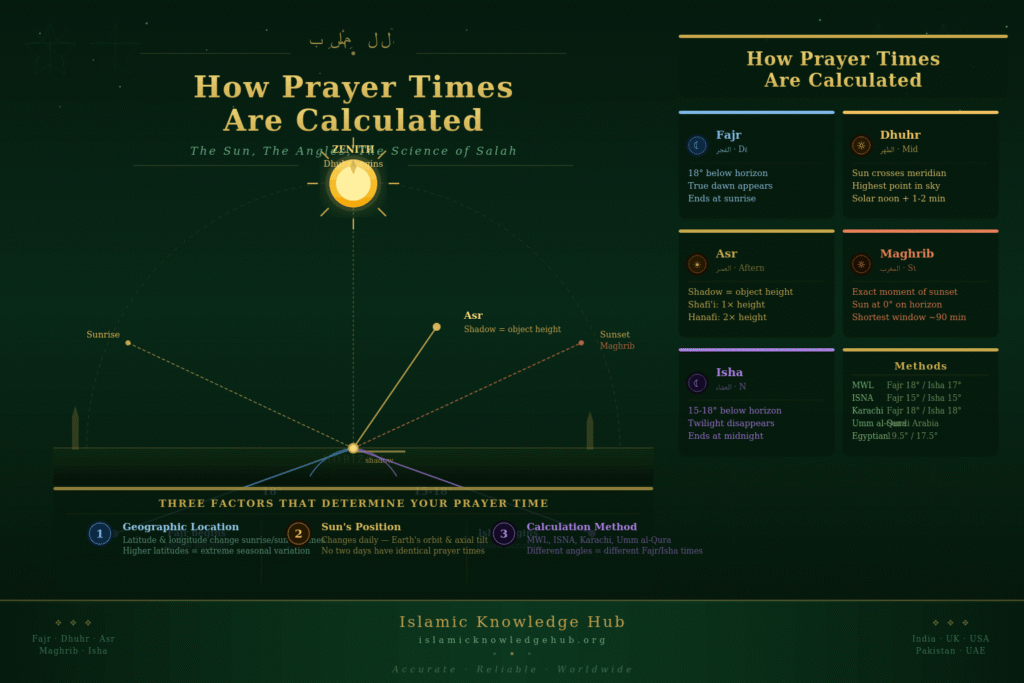
How Islamic Prayer Times Are Calculated
Understanding how your prayer timetable is calculated helps you trust the timings and explain them to others. Prayer times are not arbitrary — they are rooted in astronomy, confirmed by Islamic jurisprudence, and refined over centuries of scholarship.
The Role of the Sun
Every prayer time is defined by the sun’s position relative to your location on Earth:
- Fajr begins at astronomical dawn, when the sun is 15–18 degrees below the horizon
- Dhuhr begins when the sun crosses the meridian (its highest point)
- Asr is calculated based on the length of shadows
- Maghrib begins at sunset (sun at 0 degrees on the horizon)
- Isha begins when twilight ends, typically when the sun is 15–18 degrees below the horizon after sunset
Because the Earth rotates and tilts throughout the year, these positions change every single day — which is why prayer times are different each day and why no printed yearly calendar is ever perfectly accurate for your exact GPS coordinates.
Recognised Calculation Methods
Different Muslim organisations around the world have standardised the angles used to calculate Fajr and Isha times. The most widely recognised methods are:
Muslim World League (MWL): Uses 18° for Fajr and 17° for Isha. Widely used across Europe, the Far East, and parts of Africa.
University of Islamic Sciences, Karachi: Uses 18° for both Fajr and Isha. The dominant method across Pakistan, Bangladesh, and Afghanistan, and also widely followed for prayer times in India.
Islamic Society of North America (ISNA): Uses 15° for both Fajr and Isha. The standard method for Islamic prayer times in the USA and prayer times in Canada.
Umm al-Qura, Makkah: The official method of the Kingdom of Saudi Arabia, used for salah times in Saudi Arabia, UAE, and much of the Gulf region.
Egyptian General Authority of Survey: Commonly used across Egypt, Syria, Lebanon, and parts of Africa.
Our prayer times widget uses these globally recognised methods based on your location to give you the most accurate namaz time for your regio
Prayer Times Around the World — A Global Muslim Ummah
One of the most awe-inspiring realities of the five daily prayers is that they never stop. As the Earth rotates, the times move westward, and somewhere in the world, Muslims are always praying. It is a continuous circle of worship that links every corner of the globe.
Here is how Muslim prayer times vary across major Muslim communities worldwide:
Prayer times in India — With over 200 million Muslims, India has one of the largest Muslim populations in the world. Prayer times differ significantly across the country’s size. Fajr in Kashmir arrives much earlier than in Kerala. Cities like Hyderabad, Mumbai, Delhi, Chennai, and Lucknow all have distinct timings based on their longitude and latitude. Use our India Prayer Times page for city-specific accuracy.
Prayer times in the UK — British Muslims experience some of the most dramatic seasonal variation in prayer times of any Muslim community globally. London’s Fajr in June can be as early as 2:30 AM, while Isha does not begin until after 10:30 PM — leaving an impossibly short night. UK Muslims often follow specific scholarly guidance for these extreme latitudes. Find your timings on our UK Prayer Times page.
Prayer times in the USA — From New York to Los Angeles, Houston to Chicago, Muslim prayer times in the USA follow the ISNA calculation method in most mosques. Time zones play a major role — a Muslim in Seattle and a Muslim in New York are praying Fajr nearly three hours apart. Visit our USA Prayer Times page for state and city-specific salah times.
Prayer times in Pakistan — Karachi, Lahore, Islamabad and Peshawar follow the University of Islamic Sciences Karachi method. Pakistan’s prayer timetable is closely followed by millions in the diaspora communities of the UK, UAE, and USA. Check our Pakistan Prayer Times page.
Prayer times in the UAE — Dubai, Abu Dhabi, and Sharjah follow the Umm al-Qura method. Prayer times in the UAE are among the most searched globally due to the large expat Muslim community. Get accurate timings on our UAE Prayer Times page.
Prayer times in Canada — Canadian Muslims in Toronto, Vancouver, and Ottawa face significant seasonal variation. The ISNA method is standard here. Visit our Canada Prayer Times page.
Sunnah Prayers — Beyond the Five Obligatory Salah
The five daily prayers are fard (obligatory), but the Prophet ﷺ also consistently prayed additional voluntary prayers known as Sunnah Muakkadah — confirmed Sunnah prayers that should not be missed without a reason. These include:
- 2 rak’ahs before Fajr — described by the Prophet ﷺ as better than the world and everything in it
- 4 rak’ahs before Dhuhr and 2 after — among the most consistent of the Prophet’s ﷺ daily practices
- 2 rak’ahs after Maghrib
- 2 rak’ahs after Isha
Praying these Sunnah prayers consistently has a profound cumulative spiritual effect. The Prophet ﷺ said that whoever prays twelve rak’ahs of Sunnah daily, Allah will build a house for them in Jannah. (Sahih Muslim)
In addition, Tahajjud — the voluntary night prayer prayed in the last third of the night — is among the most beloved acts of worship to Allah. Many Muslims set their alarms between Isha and Fajr specifically to pray Tahajjud, making the fajr prayer time a natural anchor point for calculating when to rise.

Jumu’ah — The Blessed Friday Prayer
Every Friday holds a special place in the Islamic week. The Prophet ﷺ described Friday as the best day on which the sun rises. The Jumu’ah prayer — the Friday congregational prayer — replaces Dhuhr on that day and is obligatory for every adult Muslim male who is able to attend.
Unlike the fixed astronomical calculation of the five daily prayers, the exact Jumu’ah time varies by mosque, as it is held after the Dhuhr time begins. Most mosques hold Jumu’ah between 12:30 PM and 2:00 PM, though some communities hold it earlier or later.
Arriving early for Jumu’ah carries immense reward. The Prophet ﷺ described those who arrive in the first hour as having offered a camel in charity, those in the second hour a cow, and so on. (Bukhari and Muslim)
Always check with your local mosque for their specific Friday prayer timetable.
Tips for Never Missing a Prayer
Knowing the salah times is the first step. Actually praying them consistently is the lifelong journey. Here are practical ways to help build that consistency:
Set a reminder for every prayer. Use your phone’s alarm or a dedicated Muslim prayer app to alert you at least 10 minutes before each prayer begins. The Adhan itself is a built-in reminder, but in places where you cannot hear the Adhan, your phone becomes your muezzin.
Know your prayer window, not just the start time. Many people think they have “missed” a prayer when actually they are still within its window. Knowing that Dhuhr runs from 12:15 PM until 3:30 PM (for example) gives you confidence to pray whenever you have a moment, rather than assuming it is too late.
Combine travel prayers when needed. Islamic fiqh permits combining Dhuhr with Asr, and Maghrib with Isha, during genuine travel (safar). This is a mercy from Allah, not an excuse for laziness. Knowing this ruling removes the anxiety many travellers feel about missing prayers during long journeys.
Build a prayer corner at home. Having a dedicated, clean space with a prayer mat and Qibla direction marked makes it far easier to pray on time. When prayer has a physical space, it becomes a habit.
Make dua for consistency. The Prophet ﷺ made the most consistent dua: “Ya muqallibal quloob, thabbit qalbi ‘ala deenika” — “O Turner of hearts, keep my heart firm upon Your religion.” Salah on time requires a firm heart, and that firmness is a gift from Allah, asked for through dua.
Stay Connected to Allah Through Every Prayer
The five daily prayers are not a burden placed upon believers — they are a gift. In a world that constantly pulls attention in every direction, Allah gives Muslims five guaranteed moments every day to stop, breathe, remember, and reconnect. The Islamic prayer timetable is not just a schedule. It is the architecture of a life lived with purpose.
Whether you check prayer times today for Fajr before you sleep, or look up Maghrib time as you drive home from work, or confirm Isha prayer time before the day ends — every search for namaz time is, in itself, a small act of remembrance.
Use the prayer times widget above to find your accurate salah times right now, wherever you are in the world.
May Allah make us among those who guard their prayers, observe them on time, and find peace in every salah.
آمين يا رب العالمين
Q: What are the five daily Islamic prayer times?
A: The five daily Islamic prayers are Fajr, Dhuhr, Asr, Maghrib, and Isha. These prayers are performed at specific times of the day based on the position of the sun. Muslims around the world follow these prayer times as part of their daily worship and connection with Allah.
Q: How are Islamic prayer times calculated?
A: Islamic prayer times are calculated based on the position of the sun and geographic location. Factors such as latitude, longitude, and time zone are used to determine the exact prayer times for each city.
Q: How can I find accurate prayer times for my city?
A: You can find accurate Islamic prayer times by using an online prayer time calculator or Islamic prayer timetable that uses your city or location to determine the correct timings.
Q: How many Rakats are in the five daily prayers?
A: The obligatory Rakats for the five daily prayers are:
Fajr – 2 Rakats
Dhuhr – 4 Rakats
Asr – 4 Rakats
Maghrib – 3 Rakats
Isha – 4 Rakats
Q: Can prayer times be different in different countries?
A: Yes, Islamic prayer times vary from country to country and city to city because they depend on the local sunrise, sunset, and geographical location.